
England Beat India in a Lord's Classic: The 3rd ODI That Had Everything

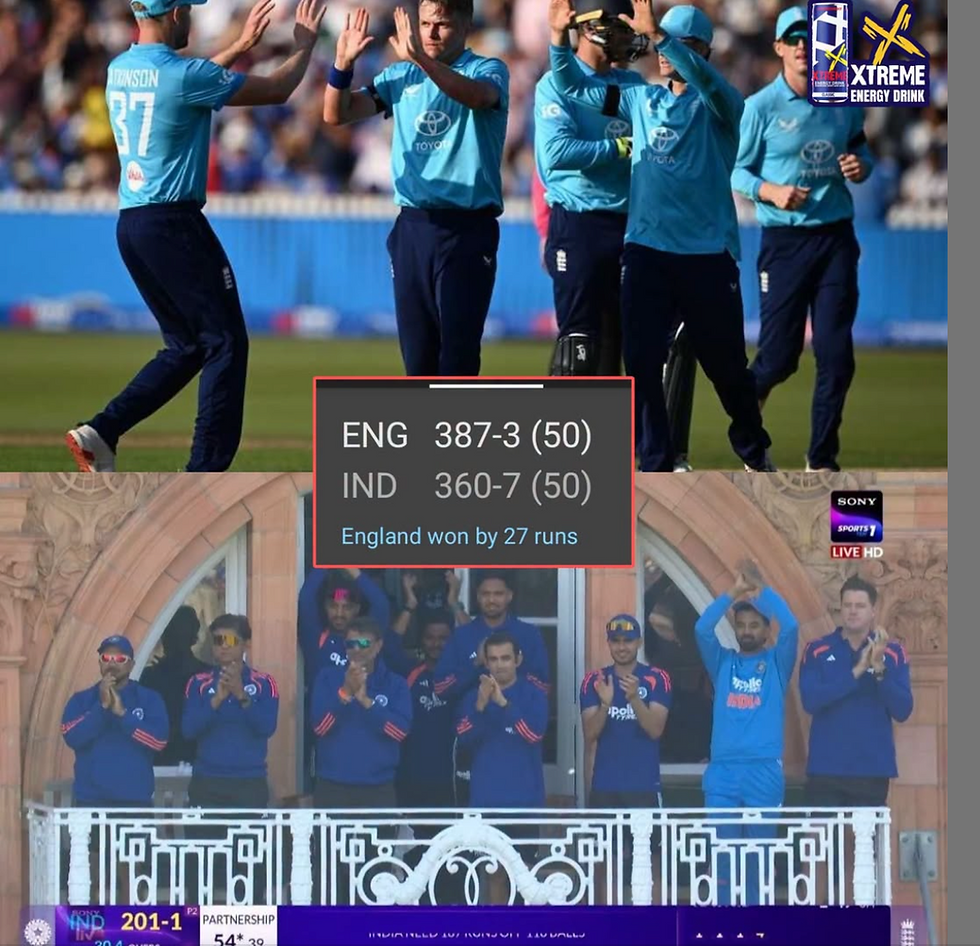
There are cricket matches and then there are cricket matches at Lord's. The home of cricket has a way of elevating everything it touches — the stakes feel larger, the silences feel heavier, and a century at that ground carries a weight that no other venue in the world can replicate. On July 19, 2026, Lord's staged a series decider between India and England that delivered everything the occasion demanded: a mammoth total, a magnificent chase, centuries from some of the finest batsmen of their generation, and a result that settled a tightly contested three-match ODI series in England's favour by 2-1.
England won by 27 runs. The scoreline reads 387 for 3 against India's 360 for 7. But those numbers, as clinical as they appear, tell only part of the story. The full story is about Ben Duckett producing the greatest individual ODI innings ever seen at Lord's, about Jacob Bethell announcing himself on the biggest stage of his young career, about Joe Root and Jos Buttler providing the kind of death-over flourish that English cricket used to be known for before they learned to bat through the whole innings. It is about Rohit Sharma arriving at the crease under the weight of retirement speculation and responding with a 110-ball 138 that turned a rout into a contest and a contest into one of the great Lord's afternoons. It is about Virat Kohli contributing 74 with the elegance and the gear shifts that have defined fifteen years of ODI excellence. And it is about England's bowlers refusing to blink in the final ten overs, when India needed the impossible and came breathtakingly close to achieving it.
This is the full story of the match that concluded the India tour of England 2026.
The Context: A Series That Had Already Delivered
To understand what the third ODI meant, it helps to understand how the series got to Lord's level at one apiece.
The first ODI at Edgbaston on July 14 was India's match from start to finish. England posted 258, a competitive total but not an imposing one on a Edgbaston surface that offered something for the seamers early before flattening out. India's chase was clinical. Shubman Gill anchored the innings expertly, and the middle order ensured there were no moments of real panic. India reached 262 for 4 with 28 balls to spare, winning by six wickets and putting themselves in a strong position to claim the series.
The second ODI at Cardiff on July 16 swung dramatically the other way. India posted only 233, a total that England's aggressive top order was always going to pursue with confidence on a Cardiff surface that historically favours batting under lights. England chased it down in 44.1 overs, winning by four wickets with 35 balls remaining. England's bowlers had restricted India to a below-par total, and their batsmen made the target look relatively straightforward. Suddenly, the series was level and everything depended on Lord's.
It was during the Cardiff match that the retirement speculation around Rohit Sharma first began circulating publicly. Rohit had made 11 in the first ODI at Edgbaston and 26 off 47 balls at Cardiff — scores that did nothing to silence the growing murmur that the selectors were looking toward younger openers with the 2027 ODI World Cup on the horizon. Cricinfo reported that selectors had communicated to the 39-year-old that opportunities for younger players would be prioritised going forward. The BCCI secretary Devajit Saikia quickly dismissed the chatter, telling PTI: "I want to firmly assert that there has been no such discussion that Rohit will be playing his last match at Lord's on Sunday." But the noise was there, and Rohit would have heard every word of it.
At Reddy Anna, we followed every ball of this series, and what the Lord's decider provided was exactly what a series decider should: two teams fully aware of the stakes, two sets of cricketers performing at the outer edge of their capability, and a crowd at the home of cricket that responded to every boundary and wicket with the appreciation that a match of this quality deserved.
England's Innings: Duckett, Bethell, and a Historic Total
England captain Harry Brook won the toss and opted to bat first on a Lord's surface that rewarded positive batting from the outset. The decision proved inspired.
Ben Duckett and Jacob Bethell walked out to open the England innings and proceeded to put on a partnership that will be talked about by Lord's members for years. The two left-handers complemented each other beautifully — Duckett's aggressiveness through the offside and Bethell's willingness to use the crease and find gaps through the leg side gave India's bowlers no consistent line to settle on.
Bethell had made 14 and 4 in the first two matches of the series, which made his selection as opener a gamble that England's management were still publicly backing. On Sunday at Lord's, he justified that faith in 93 deliveries. He hit with timing and placement rather than raw power, working the ball into gaps, rotating strike intelligently, and playing the big shots only when the conditions invited them. He finished on 91, dismissed by Prasidh Krishna via a catch by Rohit Sharma at fine leg, nine runs short of what would have been a well-deserved maiden ODI century. The dismissal brought groans from the England supporters in the crowd — Bethell had earned his hundred.
By the time Bethell departed, England were past 192 for 1, and the foundation for something extraordinary had been laid. The partnership of 192 between Duckett and Bethell was a new record for any England wicket against India in ODI cricket. It was also the first century opening stand for England's top two since Dawid Malan and Jonny Bairstow in the 2023 ODI World Cup.
Duckett continued after Bethell's dismissal as though nothing had changed. He has always been an uncomfortable cricketer to bowl at when he is in rhythm — compact, hard-hitting, difficult to set fields for because he scores all around the wicket with genuine power — and on this Sunday afternoon at Lord's, he was playing the innings of his career. He reached his fourth ODI century to warm applause from a full Lord's ground and kept going. When he was finally dismissed for 141, caught and bowled off a Prince Yadav delivery by way of a return catch, England were past 300 and accelerating.
Duckett's 141 is now the highest individual ODI score ever recorded at Lord's. England's total of 387 for 3 is now the highest List A total at Lord's, surpassing records that had stood for decades. It was also England's highest ever ODI total against India. Records were being broken at a venue that was opened in 1814 — the sheer weight of cricket history at Lord's makes such milestones feel different, more permanent, more significant.
Joe Root and Jos Buttler provided the finishing touches in the death overs with a partnership that was as brutal as it was efficient. Root was unbeaten on 74 off 48 balls at the close of the England innings — a sixth consecutive ODI fifty from a batsman who, at 35, is playing some of the best white-ball cricket of his career. Root's Player of the Series award, which came with 249 runs across three matches at an exceptional average, was as deserved as any such award in this series.
Buttler, recalled to the England fold having gone through a difficult period of form, produced an extraordinary 41 off just 13 balls in the death overs. It was a reminder that when Buttler connects cleanly, there are few batsmen in the world who can hit the ball harder or find gaps that appear to have been closed. His cameo pushed England from a very good total to an almost impossible one.
Prasidh Krishna was India's most effective bowler, picking up wickets when India needed them most and maintaining discipline when other bowlers lost their lines. India's bowling unit was missing the irreplaceable presence of Jasprit Bumrah in the playing XI, which meant the pressure on Krishna, Arshdeep Singh, and the supporting cast was significantly greater than it would have been in a full-strength attack.
England finished on 387 for 3. India needed 388 to win the series. Nobody in the ground believed they could do it. Then Rohit Sharma walked out to bat.
India's Chase: Rohit Answers Every Question
The weight of everything — the series, the retirement speculation, fifteen years of ODI cricket, the noise that had been building since Cardiff — seemed to settle on Rohit Sharma's shoulders as he walked down the Lord's pavilion steps and out through the famous Long Room. At 39, still just playing ODI cricket having retired from Tests and T20Is, facing a target of 388 on a ground where he had scored runs before, he faced a choice that every great batsman eventually faces: find another answer, or accept that the answers are running out.
What followed was one of the great individual ODI innings played in England by an Indian batsman.
Rohit attacked from the first over. There was no caginess, no tentative probing of the conditions — he came out swinging, treating the total not as impossible but as a challenge to be attacked rather than absorbed. He hit boundaries through the offside with the elegance that has always made him such a distinctive batsman to watch, the extra time he seems to create when the ball is in the air allowing him to place shots into gaps that other batsmen cannot find. He drove, he pulled, he swept, and when the bowlers pitched it up, he drove again.
He reached 50 with the required rate still just about manageable. He reached 100 — his 34th ODI century, his eighth in England alone — with the crowd on their feet at Lord's, regardless of which team they were supporting. A century at Lord's from Rohit Sharma, chasing 388, in what might be his final innings at this ground: it was the kind of moment that cricket alone can produce.
Shubman Gill provided crucial support at the other end, contributing 77 runs in a partnership that kept India's chase mathematically alive deep into the middle overs. Then Virat Kohli joined Rohit, and for a period in the middle of India's chase, the combination of those two batting together at Lord's produced a passage of play that reminded the watching world why these two have been the heartbeat of Indian batting for the better part of a decade and a half. Kohli's 74 was full of the characteristic gear shifts — quiet periods of accumulation followed by sudden explosions of boundaries that immediately changed the required run rate calculation.
When Rohit was eventually dismissed for 138, the target had been brought from 388 to a figure that India's middle and lower order could theoretically reach if they batted with extraordinary freedom. He walked off to a standing ovation from the Lord's crowd — home supporters, away supporters, and the neutrals all rising together to acknowledge an innings that transcended the result.
India needed 151 off 82 balls when Rohit was dismissed. The required rate had climbed to approximately 11 per over. In the era of T20 cricket and expanded batting depth, that is not an impossible equation, but it is an extremely difficult one, especially when the batting still to come is not calibrated for that kind of explosion.
India's lower order — Gurnoor Brar, Arshdeep Singh, and others — swung hard in the final overs, and the scorecard shows them taking 93 runs off the last ten overs, which is a remarkable achievement at any level of cricket. But 388 is simply too many when the top order has used up the bulk of the balls and the required rate has climbed beyond what fast-scoring middle order batsmen can sustain for ten overs. India finished on 360 for 7, falling 27 runs short. England won by 27 runs to claim the series 2-1.
Rohit's Response to the Retirement Question
After the match, Rohit Sharma addressed the speculation about his future with the quiet directness of someone who has been managing public noise for long enough to know how to respond without revealing more than he chooses to.
"Look, my job is with the bat. Come and play, represent my country, represent the team," Rohit told BCCI's official media team after the game. "That's what I've been told to do since I made my debut. So that's what I'm going to do. You know, the noise since I made my debut was there. And till the time I'm going to stay here, it's always going to be there. So it doesn't really matter too much. What matters is what I do on the field: try and contribute to the success of the team."
Shubman Gill, India's Test and ODI captain, was equally measured at the press conference. "He has not told us anything," Gill said when asked about Rohit's retirement. "I think it is all out in the media. There has been no such discussion in the team."
Sky Sports pundit Ravi Shastri, Rohit's former India coach, was less measured and rather more direct. He said Rohit had "shut everyone up" with his century against England after the retirement chatter that had dominated the build-up to the Lord's match.
The truth, as it usually is with questions about when great players choose to leave, is that nobody outside the player himself knows. What the Lord's innings demonstrated was that Rohit Sharma at 39, even in a losing cause, against a quality England attack, chasing an almost impossible total, can still produce an innings that stops a ground in its tracks. That is a rare quality, and it does not disappear quickly.
England's Series Win in Context
England's 2-1 ODI series win is their first against India since 2018. It is only their eighth ODI series win against India in 22 attempts — a statistic that illustrates how heavily this particular bilateral contest has favoured India over the years. Winning it at home, in a series that came down to a final-match decider at Lord's, carries genuine significance for Harry Brook's England side.
The series win comes on the back of a 4-0 T20I series win earlier in the tour, which means England have dominated the white-ball leg of India's 2026 visit to England comprehensively. The T20I result was decisive; the ODI series was a far closer contest that could have gone either way. India's win in the first ODI at Edgbaston showed they are more than capable of matching England in English conditions with the right batting performance. The third ODI showed that England, at their best with both bat and ball, are a formidable white-ball side.
Jacob Bethell's promotion to opener and his 91 in the decider is one of the significant individual stories of the series. He was backed through two low scores before delivering on the biggest occasion. Joe Root's Player of the Series with 249 runs was a reminder that Root, when he commits to the ODI format, is one of the best fifty-over batsmen in the world. Jos Buttler's death-over cameo at Lord's showed that when he is hitting cleanly, he changes what is possible in the final ten overs.
For India, the series result is a reminder that the white-ball transition — from the era of Rohit and Kohli toward the Shubman Gill generation — is a work in progress. Bowling without Bumrah was always going to make life harder, and the absence of that singular match-winning force with the ball was felt across all three matches. India's bowling unit is capable, but it is not the same unit when Bumrah is not there, and that is a vulnerability that teams are beginning to plan around.
The Bigger Picture: Lord's and the Legacy of This Match
At Reddy Anna, we believe that cricket's great venues have a way of hosting matches that become more than the result. Lord's in 2026 delivered Ben Duckett's 141 — the highest individual score ever at the ground in List A cricket. It delivered England's 387, the highest ever List A total at the same venue. And it delivered Rohit Sharma's 138 in what may or may not be his final innings at the home of cricket, in a chase that came within 27 runs of completing what would have been one of the great ODI run chases of all time.
None of those individual records or personal storylines determined who won the series — England's relentless batting depth and their bowlers' composure under pressure did that. But all of them contributed to an afternoon at Lord's that will be replayed and discussed long after the 2027 World Cup squad has been announced and this particular chapter of Indian cricket has closed.
Lord's tends to do that. It makes ordinary matches memorable and memorable matches historic. July 19, 2026 belongs in the second category.
Final Scorecards
England: 387 for 3 (50 overs)Ben Duckett 141 | Jacob Bethell 91 | Joe Root 74* | Jos Buttler 41*Prasidh Krishna — best figures for India
India: 360 for 7 (50 overs)Rohit Sharma 138 | Shubman Gill 77 | Virat Kohli 74Adil Rashid 1/64 — best figures for England
Result: England won by 27 runsSeries Result: England won 2-1Player of the Match: Jacob Bethell (91 & 1/49)Player of the Series: Joe Root (249 runs)


