
Rashid Khan Seals World Cup Spot and 2-0 Series Lead in Belfast Thriller


There are performances that win matches. There are performances that win series. And then there are performances that win the future — moments so consequential that their significance stretches well beyond the scoreboard and into the history of a cricket nation still writing its story in the game's permanent record. At the Civil Service Cricket Club, Stormont in Belfast on August 10, 2026, Rashid Khan produced one of those performances: three wickets with the ball to dismantle Ireland's batting, an unbeaten 37 with the bat to drag Afghanistan home from the edge of defeat, and in doing so, secured something more significant than a series result.
A match that swung wildly from one side to the other eventually ended with Afghanistan clinching a thriller to seal their spot in the 2027 ODI World Cup in Southern Africa, courtesy of their global superstar, Rashid Khan.
The victory not only gave Afghanistan a 2-0 lead in the series but also confirmed their place at next year's ODI World Cup, marking their fourth consecutive appearance at the prestigious tournament.
The number — fourth consecutive — is one of the most extraordinary in modern cricket's expansion story. A country that did not play Test cricket until 2018, that built its cricketing infrastructure in the shadow of decades of conflict and instability, that produced cricketers who learned the game in refugee camps and on dust pitches with improvised equipment, has now qualified for four consecutive ODI World Cups. The Belfast result did not just win a cricket match. It confirmed Afghanistan's permanent place in the upper tier of global ODI cricket.
The Series So Far: Context and Momentum
To understand what Monday's third ODI meant for both teams, the brief but dramatic series history that preceded it requires telling.
The first match — the opener of a five-game series — was abandoned without a ball bowled due to rain. Ireland's weather, a constant protagonist in any cricket staged in Belfast, denied both teams the competitive start they had planned for. One abandoned match, no result, and the series sitting at an ambiguous 0-0 heading into the second game.
The second ODI changed the conversation entirely. Rashid Khan took six wickets as Afghanistan hammered Ireland by 92 runs in the second one-day international. Victory saw Afghanistan take a 1-0 lead in the five-match series after the first ODI was washed out. Ireland lost seven wickets for 63 runs as they were bowled out for 207 chasing a target of 300 at Bready Cricket Club in the Northern Irish village of Magheramason. Khan, one of the outstanding leg-spinners of his generation, took four of the last seven wickets to fall as he finished with impressive figures of 6-34 — his third "six for" in ODI cricket.
A six-wicket haul. A 92-run victory margin. Afghanistan's bowling had dismantled Ireland with a combination of Rashid's leg-spin and the supporting cast of spinners who have made Afghanistan one of the most dangerous bowling sides in world cricket. The 1-0 lead going into the third match was a position of clear advantage — and the 2027 World Cup qualification arithmetic meant that another Afghanistan victory would clinch direct entry to the showpiece before the series was even halfway complete.
Ireland, trailing 1-0 and with the mathematical reality of what another defeat would mean for their own qualification picture, arrived at Stormont knowing they needed to produce the performance of their series. What they produced was very nearly enough — and the fact that it was not enough had almost everything to do with the man who has defined Afghanistan cricket for a decade.
Ireland's Innings: Collapse and Recovery
Afghanistan won the toss and opted to bowl first, and their decision quickly paid dividends as Ireland found it difficult to establish momentum with the bat.
The conditions at Stormont — a ground that sits alongside one of Belfast's most historic parliament buildings, the grass a deep Irish green in August, the overhead conditions offering the kind of cloud cover that pace bowlers cherish — were perfectly suited to Afghanistan's decision to field. The early morning humidity in Belfast creates movement through the air and off the seam that makes life genuinely difficult for any top-order batsman, and Ireland's openers walked out knowing the conditions would test them.
Ireland lost Andrew Balbirnie early on at 19 for 1 before Paul Stirling made 23 and Cade Carmichael added 44 runs. Stirling — Ireland's most experienced and most dangerous batsman — provided a brisk start before being dismissed just as he was threatening to build something substantial. Carmichael offered more patient resistance, his 32 from 52 deliveries providing the kind of anchor innings that a team requires when top-order wickets fall regularly, but when he departed the Irish innings was under genuine pressure.
Then came Rashid Khan. Rashid and AM Ghazanfar spun a web around the hosts, on a surface that wasn't really all that menacing for the spinners. The combination of Rashid's leg-spin and Ghazanfar's mystery spin proved irresistible — Ireland's middle order, already under pressure from the early wickets, could not find the footwork or the game plans to counter two quality spinners operating in tandem.
Afghanistan got back into the game and reduced the side to 128 for 8 in the 30th over. Ireland were in tatters. A total below 150 seemed likely, and a target that Afghanistan would chase comfortably appeared to be the trajectory. Ghazanfar ripped through the top order to pick up the wickets of Lorcan Tucker, Curtis Campher and Ben Calitz, with Rashid and Ghazanfar having combined figures of 6 for 73 by the time Ireland's lower order arrived.
What rescued Ireland from genuine embarrassment was a ninth-wicket partnership that deserves to be celebrated as one of the most courageous and intelligent lower-order stands in Irish cricket history. That Ireland made a fist of this was down to a record ninth-wicket stand between Jai Moondra and Hoey. The pair added 76 for the ninth wicket after Ireland were in tatters at 128 for 8, all at sea against the turning ball in conditions that were far from treacherous. Hoey top-scored with 36, while Moondra made 31 enterprising runs in just his second ODI innings.
The 76-run partnership between Moondra and Hoey was not simply a statistical achievement — it changed the nature of what Ireland were asking Afghanistan to chase. A target of 206 is meaningfully different from a target of 145. It requires sustained batting rather than simply clean hitting, it gives bowlers enough runs to work with, and it offers the possibility — the real possibility — of bowling a team out if conditions assist and wickets fall at regular intervals. Hoey and Moondra, batting at nine and ten in a team that was 128 for 8, added enough runs to convert a routine Afghanistan chase into the thriller that Stormont received.
The innings ended in the 47th over when Hoey was bowled attempting a big hit down the ground off Azmatullah Omarzai. Ireland finished on 206 all out. It was better than it had looked for most of the afternoon — and it would prove to be enough to make the second half of Monday's match one of the most dramatic in recent Ireland cricket history.
Gavin Hoey: The Irish Revelation of the Series
Before turning to Afghanistan's chase and Rashid's defining innings, it is necessary to pause on Gavin Hoey — the Irish youngster who has emerged from this series as one of the most compelling individual stories in international cricket in August 2026.
Ireland youngster Gavin Hoey almost played a lone role for the hosts as he top-scored with 36 and then picked up four wickets late in proceedings to give the home side some hope.
Hoey's four wickets in Afghanistan's chase — the spell that turned a comfortable Afghanistan victory into a desperate struggle, the bowling that reduced the tourists from a position of serene comfort to something close to panic — was his best ODI bowling performance, and it demonstrated the quality of a young cricketer who is growing in stature with every match he plays.
Hoey's haul of 4/34 was his best in ODI cricket and the spinner suggested he gained some inspiration from Rashid when at the bowling crease. The admission is both humble and revealing — a young Irish leg-spinner, bowling at the Civil Service Cricket Club in Belfast against Afghanistan's batting lineup, drawing inspiration from watching the world's best leg-spinner operate at the other end. The mentorship that happened implicitly in that afternoon's cricket — Rashid's technique, his flight, his pace variation, his ability to take wickets on surfaces that did not obviously favour spin — was absorbed by Hoey and reflected back in a spell that almost pulled off one of Irish cricket's great upsets.
At Reddy Anna, we follow emerging talent in Associate cricket with the conviction that the sport's future is being written in Belfast and Kabul and Dubai as much as in Chennai and Lord's, and Gavin Hoey's performance across this series — both with bat and ball — marks him as one of the most exciting young cricketers Ireland has produced in years.
Afghanistan's Chase: Gurbaz Fires, Then Hoey Strikes
Afghanistan's chase of 207 began with the aggression and clarity that has characterised their ODI batting since Rahmanullah Gurbaz established himself as one of the most destructive openers in world cricket.
Gurbaz took the attack to the fast bowlers in the chase, feasting on anything pitched up. He was particularly aggressive against Moondra, the left-arm seamer, who didn't quite manage to extract the same movement as Adair in conditions tailor-made for the quicks in Belfast.
Gurbaz's score of 71 came off 77 balls. He slammed two fours and five sixes. With this effort, Gurbaz raced to 2,139 runs from 57 ODIs at 38.19. He slammed his 8th ODI fifty. The half-century came in characteristic Gurbaz fashion — the powerplay balls put away for boundaries, the spinners treated with the aggressive footwork that forces captains to rethink their field settings, and the running between the wickets managed with an intelligence that his explosive hitting sometimes obscures.
Gurbaz reached his 50 off 45 balls with two fours and four sixes. Afghanistan were moving toward the target with an authority that suggested the match was effectively settled. At 97 for 2 — with Gurbaz well set and the required rate entirely manageable — Afghanistan looked like comfortable winners with their best batsmen yet to come or comfortably installed at the crease.
Then Gavin Hoey changed everything.
From 97 for 2, Gavin Hoey bowled a terrific spell of legspin himself. His 4 for 34 through the middle overs — including the prized scalp of opener Rahmanullah Gurbaz for 71 — cracked the game open. The dismissal of Gurbaz was the critical wicket — removing the man who had made the chase look inevitable and replacing the certainty of his presence at the crease with the uncertainty of a middle order suddenly exposed to pressure. The wickets tumbled quickly. Ireland hit back and had Afghanistan reeling at 176 for 6.
From 97 for 2 to 176 for 6. The collapse covered nine wickets in that passage of play — Afghanistan went from comfortable to desperate in fewer than eighty balls, and the Stormont crowd, which had been quietly appreciating the visiting team's quality, found something to genuinely cheer about as Ireland's bowlers dismantled the chase that had seemed inevitable.
At 176 for 7, with Afghanistan needing 31 more runs and three wickets remaining, Ireland scented the upset. Hoey had bowled his ten overs but the damage was done — the Afghanistan tail was exposed, the target remained meaningful, and the most celebrated cricket occasion in Belfast's recent history was suddenly within reach.
At 176 for 7, Ireland were more than in with a sniff of defending 206. But Rashid held firm.
Rashid Khan: The Innings That Sealed Everything
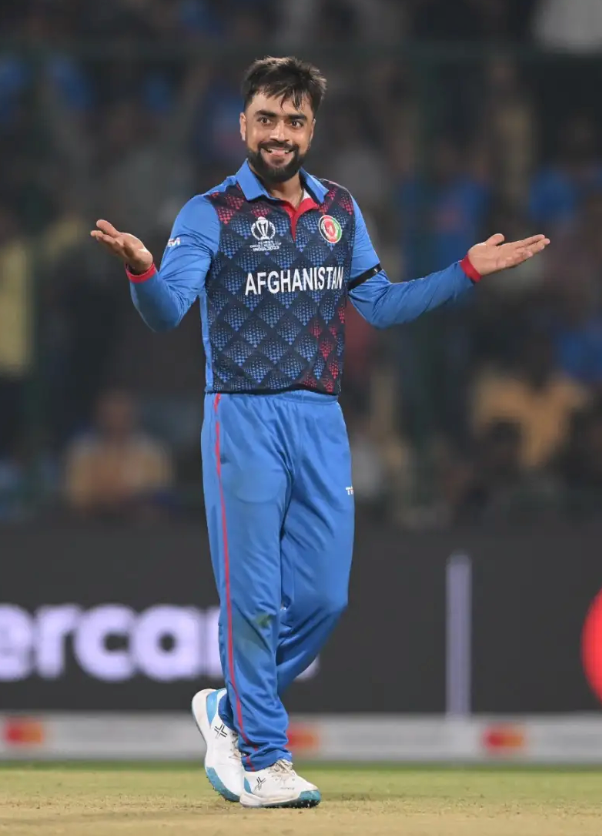
What followed was the performance that makes Rashid Khan different from every other cricketer of his generation in the context of Afghanistan cricket. Not simply his bowling — the six wickets in the second match, the three wickets on Monday that restricted Ireland to 206 — but his batting when the moment demanded it, his captaincy when the match was slipping away, and the absolute refusal to contemplate defeat that has characterised every significant Afghanistan win he has been part of.
Rashid held firm, making 37 of the most valuable runs to help his team cross the line. Rashid's batting efforts topped up a typically aggressive spell of leg-spin that fetched him 3 for 44 earlier in the afternoon.
The 37 not out from 43 balls was not a flashy innings. There were no 104-metre sixes, no audacious reverse sweeps, no shots that generated highlights reel clips. It was the innings of a captain who understood exactly what the moment required — calm accumulation, intelligent shot selection, the management of the strike to keep the bowling from the tailenders wherever possible, and the absolute composure of a man who has been in more pressure situations than almost any other cricketer of his era.
Rashid used all his experience to ensure Afghanistan got the victory.
He got them home. Afghanistan reached the victory target with more than five overs remaining — a margin of comfort that the scorecard flatteringly overstates, given that they were 176 for 7 at one point, but which reflects how calmly Rashid managed the final thirty runs once he took control of the chase. Afghanistan finished on 207 for 7. Three wickets to spare. Victory by three wickets.
The moment the winning run was scored, the Afghanistan players — fielding staff, support staff, and every member of the touring party — erupted with the specific joy of a team that has just secured something larger than a bilateral series result. The 2027 ODI World Cup place was confirmed. Afghanistan's victory confirmed their qualification for the 2027 ODI World Cup, ensuring they will feature in the global tournament for the fourth consecutive edition.
At Reddybook, we have documented Afghanistan's cricket journey with the respect it deserves since the early stages of their international career, and what the Belfast result represents is the confirmation that this is not a temporary or accidental rise. Afghanistan in four consecutive ODI World Cups is the definitive evidence that the country's cricket infrastructure — despite every obstacle — has produced a genuine, sustained, high-quality international cricket programme.
The Second ODI: Rashid's Six-Wicket Masterclass at Bready
The full story of Afghanistan's 2-0 series lead cannot be told without appropriate attention to the second ODI at Bready Cricket Club — the match that established Afghanistan's dominant position in the series and produced one of Rashid's finest individual bowling performances in recent memory.
Rashid Khan took six wickets as Afghanistan hammered Ireland by 92 runs in the second one-day international at Bready Cricket Club in the Northern Irish village of Magheramason. Ireland lost seven wickets for 63 runs as they were bowled out for 207 chasing a target of 300. Khan took four of the last seven wickets to fall as he finished with impressive figures of 6-34 — his third "six for" in ODI cricket. His best bowling in the format remains 7-18 against the West Indies in 2017.
Six wickets for 34 runs. In the context of ODI cricket — a format that has generally become more batsman-friendly with every passing year — figures of 6-34 represent a performance of extraordinary quality. The fact that this is Rashid's third "six for" in ODI cricket puts him in rare historical company. Very few bowlers in the history of the fifty-over format have taken six or more wickets in an innings three times.
The 92-run margin of Afghanistan's second-match victory was as decisive as the scoreline suggests. A target of 300 — competitive, but chaseable for a batting side of Ireland's quality with conditions in their favour — became unreachable when Rashid dismantled the middle and lower order with the combination of flight, turn, googly, and top-spinner variations that have made him the most complete leg-spinner of the modern era. The seven wickets that fell for 63 runs told the story of a batting order that simply had no answers for a bowler at the peak of his powers.
What This Series Means for Afghanistan Cricket
The 2027 ODI World Cup will be co-hosted by South Africa, Zimbabwe, and Namibia — a landmark event for African cricket's international profile, and the first major ICC tournament staged on the continent since the 2003 edition. For Afghanistan to be confirmed as participants, with two matches of the Ireland series still to play, is a statement about where the programme stands.
The result carries significance beyond the series itself. This is Afghanistan's fourth consecutive World Cup qualification — a sequence that began when they qualified for the 2015 edition in Australia and New Zealand, continued through 2019 in England and 2023 in India, and now extends to 2027 in Southern Africa. Each successive qualification is built on the institutional development — the domestic structure, the player pathway, the coaching infrastructure — that has transformed a cricket programme that barely existed twenty years ago into a permanent fixture in the global game's highest-profile event.
Rashid Khan has been present across all four of those qualification journeys. He made his international debut in 2015, played in all three World Cups since, and is now the captain of a side heading to his fourth. At 27 years old, he is simultaneously Afghanistan cricket's greatest servant to date and a player who has his best years still ahead of him. The 2027 World Cup in Southern Africa will be Rashid at his peak — a leg-spinning, lower-order batting, tactically astute captain with the specific experience of what it takes to win under pressure in international cricket's biggest arenas.
The World Cup qualification also carries implications for Ireland, whose own ranking and qualification picture has been complicated by Monday's result. Ireland's direct qualification path narrowed significantly with Afghanistan's confirmation — the remaining matches of this series, and the subsequent calendar of fixtures before the qualification cut-off, will determine whether Ireland need to take the qualifier route or can secure direct entry through their ranking position.
At reddy anna book, we cover international cricket in all its dimensions — from the glamour of India-England series at Lord's to the significance of Afghanistan-Ireland in Belfast — because we understand that the sport's richness lies precisely in this breadth. A three-wicket win at Stormont that secures a World Cup place for Afghanistan is as significant a cricket result as any played in August 2026, and it deserves the attention that a match of its consequence commands.
Rashid Khan: The Complete Modern Cricketer
The Belfast victory provides one more data point in the argument that Rashid Khan is one of the most complete cricketers of the modern era — not simply one of the best bowlers, not simply one of the most impactful franchise T20 players, but a genuinely all-round match-winner capable of influencing outcomes with bat, ball, and captaincy in any format and any condition.
His combined contribution across the second and third ODIs of this Ireland series — six wickets for 34 at Bready, three wickets for 44 and an unbeaten 37 in Belfast — represents the kind of sustained all-round excellence that very few cricketers in the history of the game have delivered across consecutive matches in a bilateral series. The bowling in the second match was dominant. The batting in the third match was courageous. And the captaincy across both — the field settings, the bowling changes, the management of a collapse from which most captains would have struggled to recover — was outstanding.
It came on the back of a six-wicket haul for Rashid in the second match of the series, with the right-armer continuing his good form with the ball ahead of next year's ICC Men's Cricket World Cup.
The 2027 World Cup framing is the right context for evaluating what Rashid is producing right now. World Cups are won by complete teams with match-winners capable of defining moments — and Afghanistan, with Rashid as their captain and their most valuable all-round player, have one of those match-winners operating at a level that the global game's best teams would envy.
The remaining two ODIs of the Ireland series — both with the series already decided and the World Cup qualification confirmed — will give Afghanistan the opportunity to continue building their fifty-over combinations ahead of next year. But the matches that truly mattered were the second and third, and in both of them, Rashid Khan delivered exactly when Afghanistan needed him most.
That is the definition of a great cricketer. Rashid Khan, at Bready and at Stormont in August 2026, has added two more chapters to a definition that the cricket world has been reading for almost a decade.


