
The Statement Innings: Abhishek Sharma Blasts 233 Off 91 Balls in Punjab District Match
- Yep Thomi
- 1 hour ago
- 12 min read

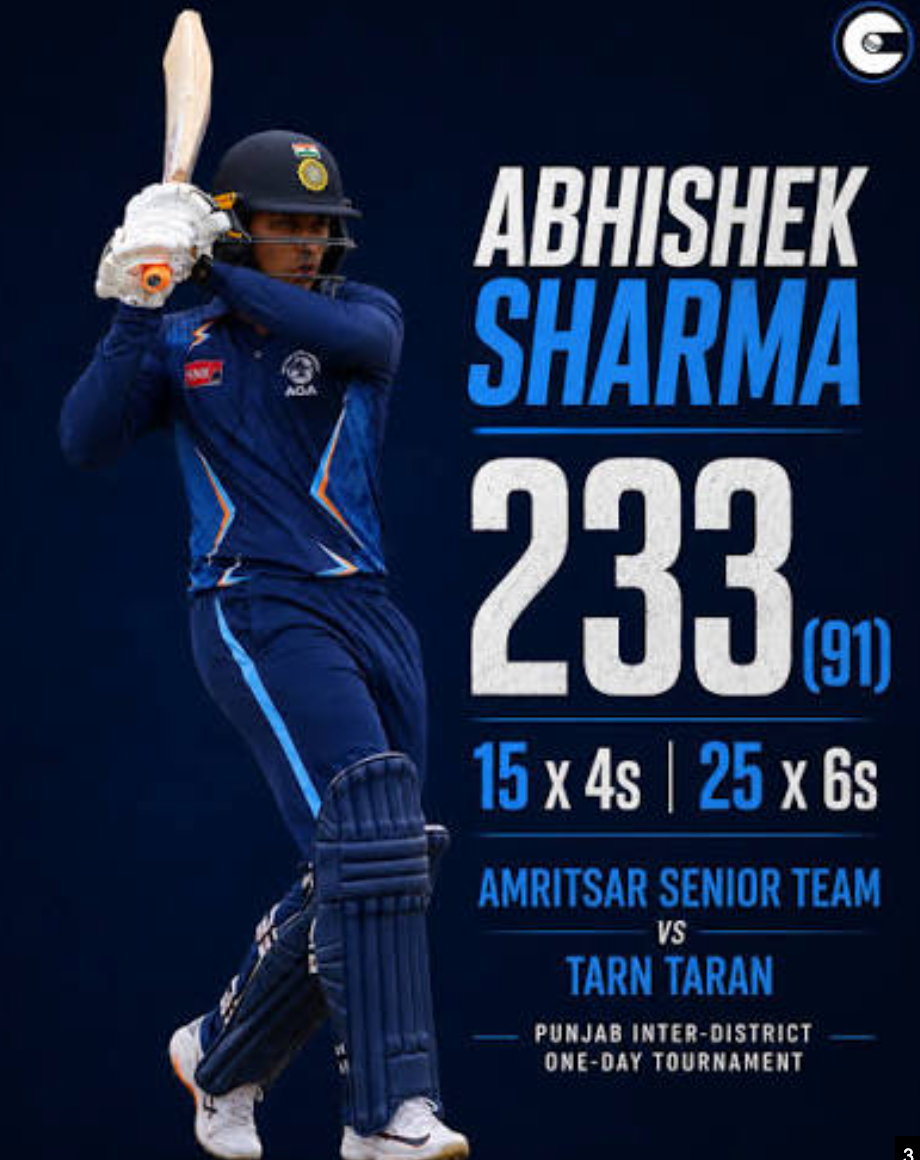
There are innings that win matches. There are innings that win tournaments. And then there are innings that win arguments — performances delivered not on the biggest stage but in the most pointed possible context, with a message so clear that no commentator, no analyst, and no selector needs it translated. On August 2, 2026, at a cricket ground in Punjab far removed from the international arenas where his form had been under scrutiny, Abhishek Sharma walked out to bat for Amritsar in the Punjab State Inter District Senior One Day Limited Overs Tournament and proceeded to produce one of the most extraordinary individual batting performances seen in Indian domestic cricket in years.
The left-handed batsman scored 233 runs from just 91 balls, hitting 15 fours and an amazing 25 sixes with a strike rate of over 256. His team, Amritsar Men Senior, posted a massive 533 for 8 in 50 overs batting first against Tarn Taran. The innings was not simply a statistical spectacle — it was a response. To the questions, the criticism, the dropping, the analysts who had said he had been figured out. To a Zimbabwe tour that had produced 11 runs across three innings. To a T20 World Cup campaign that had ended with questions rather than answers. To the very public suggestion from respected former India cricketers that the selectors needed to take a tough call on whether Abhishek Sharma could be trusted at international level.
The tough call can wait. On August 2, Abhishek Sharma batted with the ferocity and the clarity of a man who knows exactly who he is, whatever the recent scorecards might have suggested.
The Match and the Innings
The Punjab State Inter District Senior One Day Limited Overs Tournament is not a glamorous competition. It does not generate international television coverage, it does not attract the attention that the Vijay Hazare Trophy or the Syed Mushtaq Ali Trophy command, and it is not the stage where India careers are typically made or remade. That is precisely what made what happened at Amritsar on August 2 so striking — the choice to play in it, the performance within it, and the context surrounding it combined to create an event that went viral across cricket's social media ecosystem within hours of the first clips appearing online.
Abhishek Sharma played for Amritsar against Tarn Taran Men's Senior Team in the district fixture. He opened the batting, as he does for India, and he approached the innings with the same philosophy that made him famous at the international level — attack from ball one, find the boundary early, and never give the bowling side the opportunity to settle into a length or a line that might contain him.
Abhishek and Abhay Choudhary gave Amritsar a strong start, putting together a 305-run opening partnership. Abhay made 93 off 85 balls. The opening partnership of 305 is, in itself, a remarkable achievement in any fifty-over format — it is the kind of stand that makes a match unwinnable for the opposition from the moment it ends. But within that partnership, Abhishek's contribution was something else entirely.
He reached 50. He reached 100. He continued, finding gaps, clearing boundaries, hitting the ball to parts of the ground that the fielding side had no plausible response to. He was eventually dismissed caught by Anikait Singh off the bowling of Ashish Lowrance — dismissed on the fourth ball of the 25th over. He had batted for less than half the match's duration and scored 233 runs.
One of Abhishek's sixes from the innings has gone viral on social media. The clip — a flat-batted, one-handed finish over the leg side that cleared the boundary as though the fielder positioned there was an inconvenience rather than a deterrent — captures something essential about Abhishek Sharma's batting: the casual authority with which he hits cricket balls to places that other batsmen reach only when everything is perfect, delivered here as though it is the default rather than the exceptional.
Further down the order, Abhinav Sharma made a quickfire 51 as Amritsar piled on the runs across the innings, pushing the total to 533 for 8. Sunrisers Hyderabad wicketkeeper-batter Salil Arora was also part of Amritsar's playing XI, batting at No. 4 and scoring 29 runs from 18 balls.
It is worth noting the context of the team Abhishek was playing for. Amritsar's lineup for this district match included multiple players with first-class credentials and IPL connections — this was not a club cricket game against unrecognised opposition, even if the competition itself is below the highest levels of Indian domestic cricket. The bowling Abhishek faced was not international quality, but the mechanics of hitting 25 sixes in any cricket match — the timing, the power, the placement, the mental commitment to playing the same way from ball one to ball 91 — reflect real batting ability that does not disappear between formats.
The Form Context: Why This Innings Matters

The domestic heroics arrive at a time when Abhishek has struggled on the international stage. The 25-year-old batsman had a disappointing outing on India's recent tour of Zimbabwe, scoring just 11 runs in three innings at an average of 3.66.
The Zimbabwe numbers are stark. Three innings. 11 runs. An average of 3.66. For a batsman who had announced himself at international level with the kind of power hitting that made commentators reach for comparisons with Yuvraj Singh, the Zimbabwe series was a brutal reminder of how quickly the gap between potential and consistency can become a talking point in Indian cricket's relentless conversation about selection.
Blessing Muzarabani troubled him throughout the Zimbabwe series, dismissing him during a tour in which Abhishek failed to reach double figures in all three innings. Muzarabani's pace and bounce in Harare, his ability to generate awkward angles from the new ball, and his specifically targeted approach to Abhishek's technique exposed a vulnerability that the Tarn Taran bowling attack could not replicate but that Zimbabwe's coaching staff had clearly planned for.
He had also endured a difficult T20 World Cup 2026 campaign, managing only one fifty across the tournament with an average below 18 and three ducks along the way. The World Cup is the stage where reputations are made and unmade in Indian cricket — a stage where the scrutiny is global, the margin for error is minimal, and the statistical evidence of struggle accumulates in real time under the eyes of selectors, analysts, and fans simultaneously. Abhishek's World Cup numbers did not damage his reputation as dramatically as they might have for a player without his obvious talent, but they contributed to a narrative of inconsistency that the Zimbabwe series then deepened.
Since the start of the 2026 T20 World Cup, Abhishek averaged just 18.44 with a strike rate of 162.74 — a strike rate that, taken in isolation, looks reasonable for a T20 player. But for a batsman whose primary value to the team is his ability to score at 190-plus in the powerplay and change the nature of a chase before the bowling side finds its rhythm, a strike rate of 162 represents a significant drop from the levels that made him exciting in the first place.
The critical voices grew louder after Zimbabwe. Former India cricketer Kris Srikkanth did not hold back on his YouTube channel, saying opponents had clearly figured Abhishek out. "Abhishek Sharma has been sorted out by opponents in international cricket, right from the World Cup," he said. "I think a tough call has to be taken against him now. He will receive a call back 100 per cent. The selectors will have to take a tough call."
Srikkanth is not alone in that assessment. The nature of Abhishek's dismissals across the Zimbabwe series — falling to pace, bounced out, caught in the deep attempting to attack — suggested a technical pattern that opposition coaches were sharing and exploiting. When a pattern is identified and replicated across multiple series, it stops being a run of bad form and starts looking like a structural vulnerability.
The innings at Amritsar does not answer those technical questions definitively — the bowling Abhishek faced on August 2 was not the bowling that Muzarabani delivered in Harare. But it answers the broader question that runs beneath the technical ones: does this batsman still possess the ability to hit cricket balls to the boundary with extraordinary frequency and power? The answer, across 91 balls and 25 sixes, was unambiguous.
The Pressure of Vaibhav Sooryavanshi's Rise
The context of Abhishek's form struggles cannot be discussed without acknowledging the extraordinary emergence of Vaibhav Sooryavanshi — the fifteen-year-old who made his T20I debut in Zimbabwe and immediately scored 50 off 18 balls in his first innings, becoming the youngest player in history to score a half-century in international cricket.
Sooryavanshi's debut changed the conversation around India's T20 opening slots in a way that no amount of ordinary form pressure could have replicated. Before Zimbabwe, the discussion around Abhishek's place was about whether he needed more time and patience to find his best form at international level. After Zimbabwe — after Sooryavanshi's emergence, Abhay Sharma's 50 off 18 balls at the same ground where Abhishek was dismissed for 4, 4, and 3 — the discussion shifted to whether patience was still the appropriate response.
With Sooryavanshi's meteoric rise adding further pressure, Abhishek isn't the only name in the conversation for India's T20 opening spots. Sanju Samson also remains firmly in the mix, having won Player of the Tournament during India's T20 World Cup triumph.
The opening slot at international level is one of the most competitive positions in Indian cricket at any point in the sport's history — and in August 2026, it is arguably the most fiercely contested of all. Rohit Sharma has retired from T20Is. The slot is genuinely open. And the candidates include a 15-year-old who just made history in his debut, a World Cup Player of the Tournament who was dropped mid-series in England, and Abhishek Sharma — a batsman of extraordinary ability who has spent the middle of 2026 proving to himself and to watching selectors that he can find the form that made him one of Indian cricket's most exciting batting prospects in the first place.
At Reddy Anna, we follow Indian cricket's selection debates with the attention they deserve, and the competition for India's T20 opening positions heading into the Asian Games in September and the subsequent home series against West Indies is one of the most compelling narratives in the current cricket calendar. Abhishek's 233 in Amritsar has not settled that debate — but it has emphatically kept him in it.
The Decision to Play: Why It Matters
One of the most important dimensions of the Amritsar innings is the decision that preceded it — the choice by Abhishek Sharma, a full India international with IPL experience and a significant public profile, to play in a Punjab state inter-district competition that nobody outside Punjab cricket would normally notice.
One of the most encouraging aspects of this performance is Abhishek's willingness to play competitive cricket whenever an opportunity is available. Many established international players may not participate in an inter-district competition. However, Abhishek chose to spend time in the middle rather than limiting his preparation to net sessions. Batting practice in the nets is important, but match situations test a player differently.
This is a point that deserves more emphasis than it typically receives in discussions of the innings. The form guidance that India's coaching and selection structure provides to players who are out of the national team — or under pressure for their place within it — generally involves recommendations to play domestic cricket wherever possible, to get time in the middle, to work through technical adjustments in match conditions rather than in the artificial environment of the net.
Abhishek's participation in the Punjab district tournament reflects that ethos exactly. A batsman whose international form has been under question could have retreated to private net sessions, worked with coaches in a controlled environment, and waited for the next selection opportunity. Instead, he chose to bat. In a competitive match. Against bowling that he would need to hit to boundaries rather than simply block. And he hit 25 of those boundaries over the rope with the flat authority of a man who has absolutely no technical uncertainty about whether he can clear a boundary field.
At Reddybook, we believe that the willingness to do the unglamorous work — to play the district match, to bat in the tournament that nobody is watching, to trust the process even when the results at the highest level have been difficult — is one of the clearest indicators of character in a young cricketer. Abhishek Sharma's August 2 performance was spectacular in its numbers. It was significant in its intent.
The Technical Picture: What the Innings Shows and What It Doesn't
The honest assessment of what the Amritsar innings tells us about Abhishek Sharma's readiness for international cricket requires a balance between the genuine positives it reveals and the limitations of the context in which it was delivered.
The positives are clear. The hand-eye coordination, the timing, the power, and the confidence to play the same attacking game from the first ball to the last — these are qualities that do not disappear between the inter-district level and the international level, even if the results of applying them look different against international quality bowling. A batsman who has lost confidence does not score 233 off 91 balls in any format against any bowling. The fluency that Abhishek displayed against Tarn Taran tells you that the technical foundation and the mental confidence are both present in a way that the Zimbabwe numbers suggested might have been compromised.
The limitations of the context are equally clear. Tarn Taran's bowling attack is not Blessing Muzarabani. The psychological pressure of batting in an inter-district match in front of a Punjab crowd is not the pressure of batting at the Harare Sports Club in a T20I, with a struggling run of form behind you and selectors watching the live feed. The adjustment Abhishek needs to make at international level — to the pace, the bounce, and the specifically targeted plans that opposition coaches develop for batsmen they have identified as vulnerable to a particular approach — requires competitive exposure at a level closer to international cricket than an inter-district fifty-over game provides.
But here is the essential thing about form: it runs deeper than technical mechanics. A batsman who cannot find the middle of the bat — who is playing and missing, edging to the slips, getting hit on the pad — has a different problem to a batsman who is making good contact but misjudging the risk-reward calculation on specific shots against specific bowlers. Abhishek's problem at Zimbabwe looked more like the second type than the first. And the Amritsar innings — the clean striking, the full face of the bat on the sixes, the consistent placement of boundaries — confirms that the contact quality is still there.
The Bigger Picture: India's T20 Batting Transition
Abhishek Sharma's personal form struggles sit within the broader context of India's T20 batting transition — a period in which the generation that dominated the format from 2021 to 2025 is being gradually replaced by younger players who bring different skills, different profiles, and a different relationship with risk and aggression.
The transition has been uneven. Vaibhav Sooryavanshi's emergence is the most dramatic example of how quickly the landscape can change — from relative anonymity to world-record holder in a single debut innings. But the transition across the full batting lineup is creating competition at every position, and that competition is producing exactly the kind of intense, high-pressure environment in which form either solidifies or breaks.
India's next T20I assignment comes at the Asian Games in September, followed by a home series against West Indies. Both competitions provide opportunities for players under selection pressure to make their case — in match conditions, against real opponents, with selectors watching with the specific question of who to trust at the top of the order for the next T20 World Cup cycle in mind.
The Asian Games in September is likely to provide Abhishek with one of his clearest opportunities to respond to the Zimbabwe numbers in a competitive international context. How he performs against Asian opposition — in conditions closer to the T20 World Cup settings that produced his difficult campaign — will tell considerably more than the Amritsar inter-district match about where his international career is heading.
At reddy anna book, we track Indian cricket's batting talent with the conviction that the depth of the player pool in this country means that every performance — whether in an inter-district match in Punjab or a T20I in Zimbabwe — contributes to the evidence base from which selectors make decisions. Abhishek Sharma's 233 off 91 balls is a data point in that evidence base. A significant one. Not conclusive on its own, but combined with his IPL track record, his best international innings, and the character shown by choosing to play competitive cricket in difficult personal circumstances, it is a data point that speaks clearly.
The Numbers That Defined Sunday
Before the day's cricket began in Amritsar, the numbers attached to Abhishek Sharma's recent career were predominantly the disappointing ones — the 3.66 average in Zimbabwe, the sub-18 average in the T20 World Cup, the three dismissals without reaching double figures in Harare. By the end of the day, a different set of numbers had been added to the record.
233 runs. 91 balls. 25 sixes. 15 fours. Strike rate of 256.04. A 305-run opening partnership with Abhay Choudhary. A team total of 533 for 8. Dismissed in the 25th over, having scored a double century and still — still — left with 25 overs of batting to follow from the rest of the order.
The numbers of the Tarn Taran match will not appear in international statistics. They will not count toward Abhishek's T20I or ODI career record. They will not change the selection arithmetic that the Indian selectors must work through as they build squads for the Asian Games and the home series against West Indies.
But they matter. They matter because form is not purely statistical — it is psychological, habitual, and physical, and time spent in the middle hitting boundaries generates the muscle memory and the mental confidence that net sessions cannot replicate. They matter because a player who responds to a difficult run of results by playing competitive cricket wherever the opportunity presents itself is a player who understands what his career demands of him. And they matter because 25 sixes in 91 balls — at any level, against any bowling, in any competition — is not the output of a batsman who has forgotten how to bat.
Abhishek Sharma has not forgotten how to bat. Amritsar knew it. Tarn Taran certainly knew it. And the Indian selectors, watching the viral clips and the scorecard with the interest that a player of his profile always commands, will know it too.


